 CPIL Research Group
 MBZUAI
TL;DR
SCiEL is an AI system that improves itself. It does not retrain its language model. It learns from its own attempts instead: which ideas work, which tools help and what to try next. It tests every lesson before keeping it, shares it between groups that work in parallel and carries it into its next run. Each lesson makes the next one easier to find, so SCiEL gets better at getting better. This is recursive self-improvement (RSI).
- Self-improvement beats scale. With SCiEL, a free 27B model running on two GPUs sets new records on hard scientific problems, beating results that Google DeepMind and others reached with the largest closed models such as Gemini, Claude and GPT. Two of these records are already accepted into Terence Tao’s collection of open problems (Section 3).
- Open to everyone. Our arena, Empira, holds 2,260 scientific tasks in 11 fields, from mathematics and physics to biology, chemistry, robotics and finance. The code and 2,011 runs are public, and anyone can run SCiEL on their own problem today.
With an Anthropic or OpenRouter key, nothing else to set up: sciel picks the key up and asks what to improve.
export ANTHROPIC_API_KEY=...
pip install sciel
sciel
Serve an open model with vLLM or any OpenAI-compatible server and set llm.api_base: http://127.0.0.1:8000/v1 in a profile. Our runs use Qwen3.8-27B on two GPUs.
vllm serve <model> --port 8000
pip install sciel
sciel run <profile>.yaml
Use a Claude Code or Codex login: set provider: claude_code or provider: codex_responses in a profile. A run pauses when a usage limit is reached and continues after it resets.
pip install sciel
sciel run <profile>.yaml
Let Claude Code or Codex set the task up from your paper, notebook or data: the sciel-task skill writes the checker, audits the task, runs SCiEL and checks the result.
git clone https://github.com/SCiEL-RSI-CPIL/sciel-rsi-framework
cp -r sciel-rsi-framework/skills/sciel-task ~/.claude/skills/
claude "solve this with SCiEL"
Only the language model needs a GPU. The bandits (from the first step), the world model (after about 60 steps) and the step policy (after about 200) run on CPU. The world model embeds code with a small embedding server, such as Qwen3-Embedding-0.6B, or with built-in hashed embeddings that need no server. Its TabPFN stage comes with pip install "sciel[tabular]".
01SCiEL learns from the experience it produces itself
A system improves recursively when its improvements make it better at improving. SCiEL keeps the language model fixed1 and improves everything around it. Around the model it builds a repertoire: findings, tools and learned rules for choosing the next edit. It splits its programs into demes, groups that evolve on their own and in parallel. When one deme learns something useful, SCiEL tests it and passes it to the other demes as a finding; at the end of a run, it passes the repertoire to the next run (Henrich, 2016; Boyd and Richerson, 1985).
Definitions
One step of a run: SCiEL makes its choices, the model writes a child program, the checker scores it.
- the choices: the parent program , the kind of edit, the finding to show, the strategy
- the odds of the choices, learned from the journal
- the frozen language model, Qwen3.8-27B; it gets the parent and a prompt built from the choices
- the child program it writes
- the task's exact checker; is the child's score
A group of programs that evolves on its own, in parallel with the others.
- all programs of a run
- deme ; a child joins the deme of its parent
A lesson written in one deme and shown to the others. SCiEL keeps it only after a randomised trial shows that it helps.
- the finding
- two children of one trial: same parent, same edit, same seed; one is shown , the other a neutral text of the same length
- the outcome of trial : if the child shown scores higher, if lower
- the e-value after trials, a running bet against no effect
- the lower end of the confidence interval for the effect of
From run A, autocorrelation
“The structural probe confirms single active lag dominance (lag 377) and refinement invariance, supporting targeted local search on the active lag's contribution as the next candidate design step.”
A standing question that a deme studies with tools it writes itself.
- code the model writes to measure the problem
- an isolated Docker container
Everything SCiEL keeps besides the programs.
- the research cells' files that earned credit
- the world model, which predicts whether an attempt will improve its line
- the step policy and the odds of the choices
Passing the repertoire on: between demes during a run, and to the next run.
- a finding shown in deme after deme wrote it
- the repertoire the next run starts from; each item is tried again, and only the new run's own trials decide
The record of every choice, the odds it was drawn with and its outcome.
- the choice at step and its outcome
- the odds it was drawn with
- what other odds would have scored, estimated from the record alone
Our open arena: 2,260 tasks in 11 fields and the public runs, with every attempt.
How to read it
Each colour is a deme, one of 8 groups of programs evolving on their own.
Programs grow outward from the starting program at the centre.
Bigger dot, higher score.
A red arc is a finding one deme passed to another.
The ring is the best program, score 0.9994.
If we raise each program by how close it came to the best known value, the run looks like a climb up a landscape. The film shows the same view (0:50):
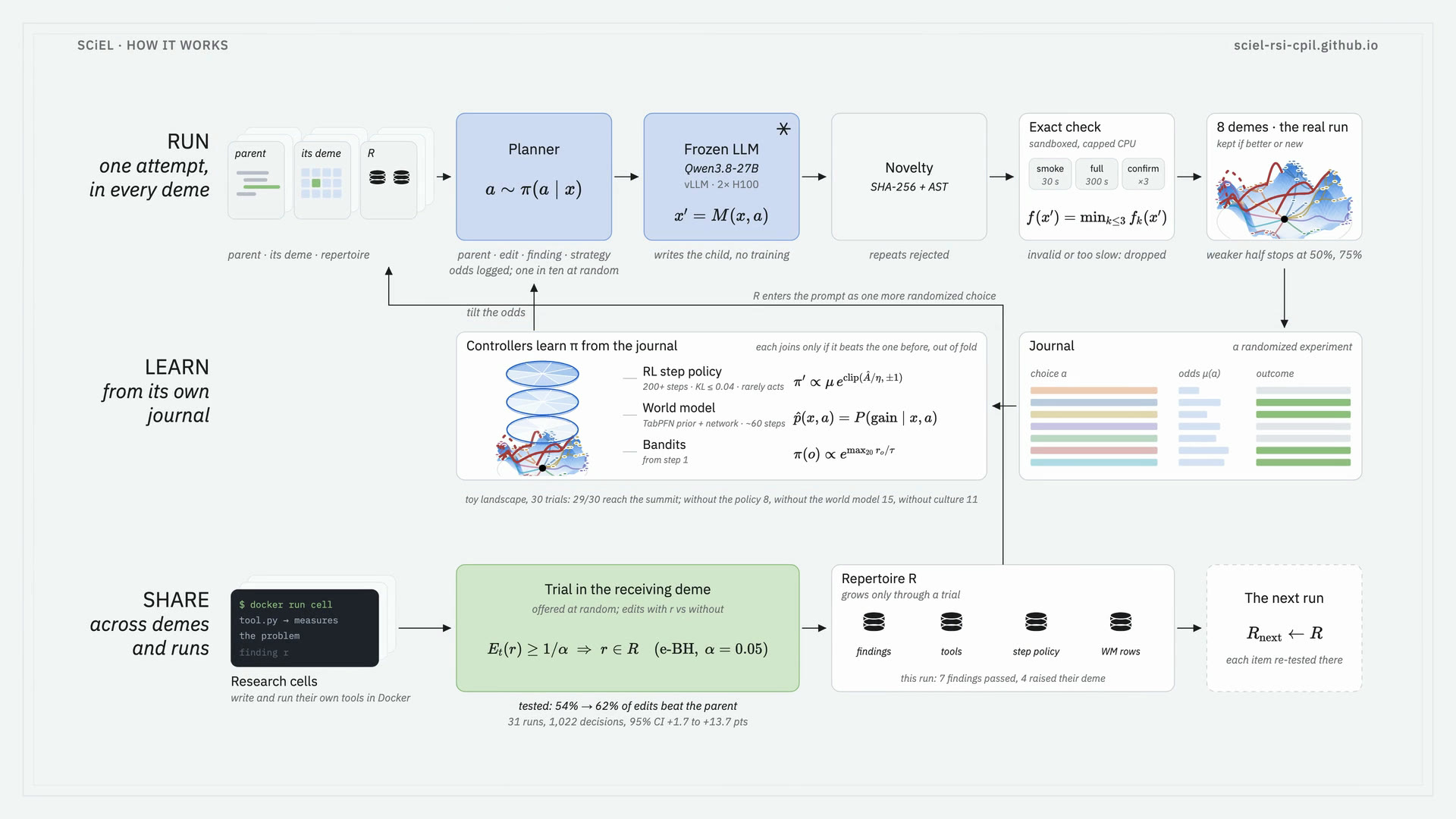
Every deme repeats the same attempt, and SCiEL learns from each one. The whole system fits on one page:
02The run's own experience steers the next attempt
Every attempt is a handful of choices: which program to start from, what kind of edit to ask for, which finding to show, which strategy to follow. SCiEL does not leave these choices to chance or to a fixed rule. It draws each choice at random with set odds, and it learns the odds from its own record of what worked. Three layers set the odds. A layer takes over only when it does better than the layer below on attempts it has not seen:
- Bandits, from the first attempt. When a kind of edit has just improved a program, SCiEL chooses it more often; it still tries the other kinds now and then, and it forgets old successes.
- A world model, from about 60 attempts. Before SCiEL calls the language model, the world model predicts whether an attempt will improve its line, and SCiEL favours the attempts it rates highly.
- A step policy, from about 200 attempts. It can shift the odds of every choice by a small, bounded amount, but only when the record shows a clear gain.
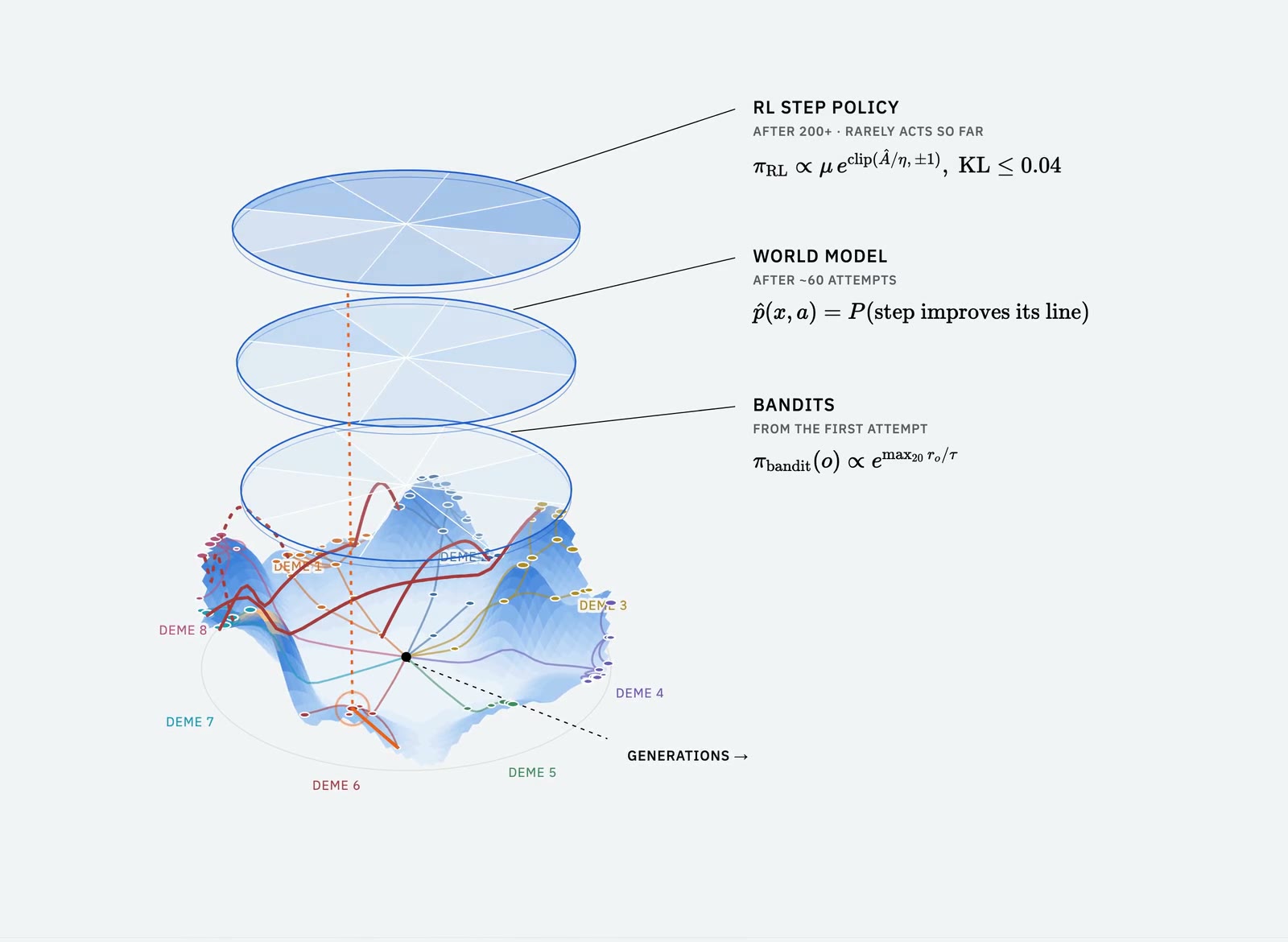
This is how SCiEL points its effort in the right direction. It does not ask the model the same question in the same way for the whole run. It asks more often about the parents, edits and findings that have just worked at this stage of the climb, and less often about what keeps failing. SCiEL still makes one choice in ten at random and records the odds of every choice. A lucky streak therefore cannot lock in the run, and the record stays a fair experiment; it is the same experiment we use to test culture in Section 5. Most attempts still do not help, so the choice of which attempts to make matters.
Here is one run, step by step, with each record and the model’s own reason for the edit:
03Recent results
Every result below comes from one open model, Qwen3.8-27B, which we run on our own machines and do not train during a run. We check each result outside the run, and the status column says where it stands. New results appear first on the results page.
| Problem | SCiEL | Previous best | Year | Reached with | Status |
|---|---|---|---|---|---|
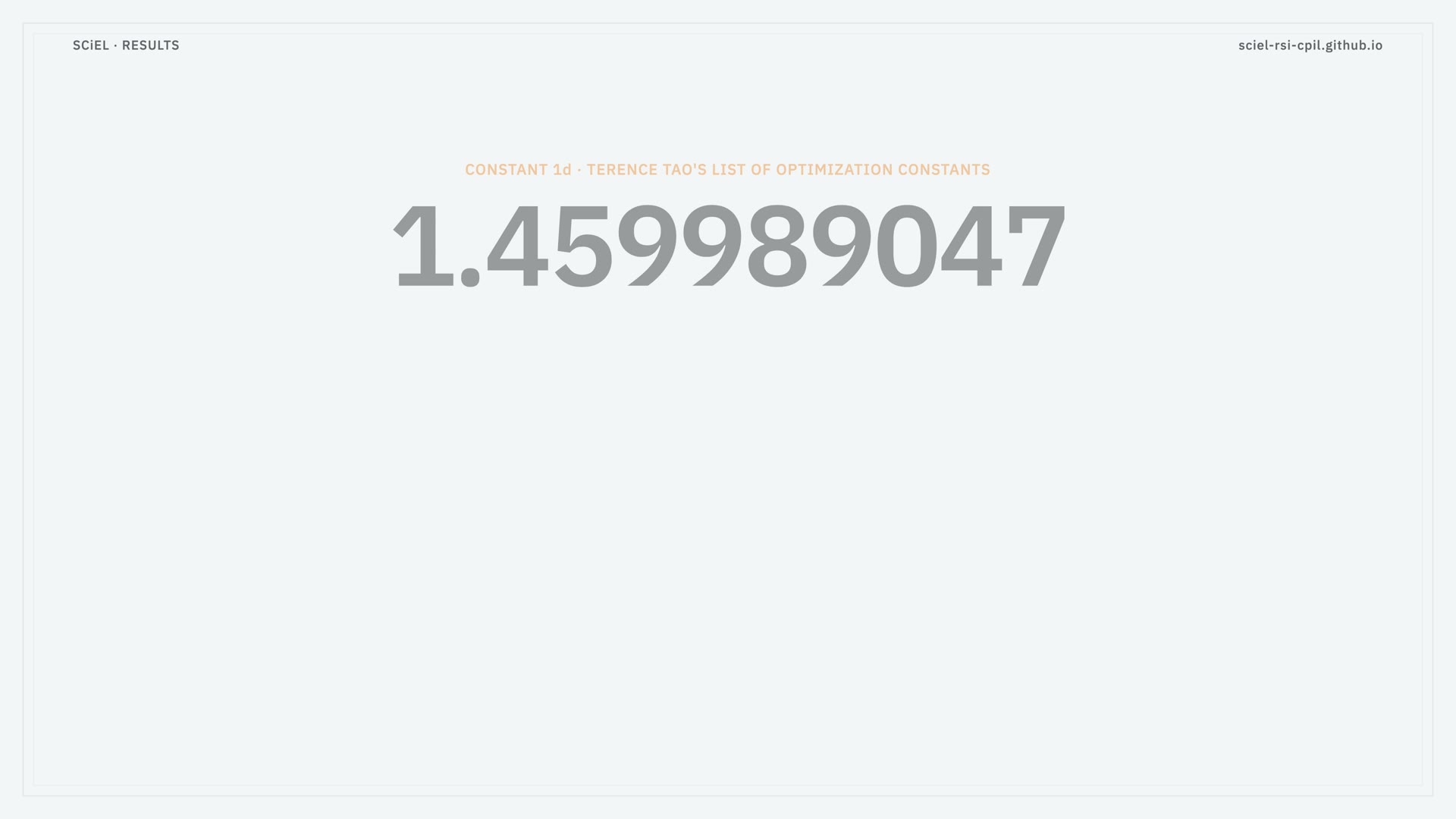
| Autocorrelation constant C1d, upper bound | NEW SOTA 1.457854885 ↗ | 1.459989047 | 2026 | gradient optimisation, open pull request; AlphaEvolve’s own bound: 1.4687621 with Gemini closed frontier | merged |
| Ramsey multiplicity of K6 (89c), upper bound | NEW SOTA 0.7422042116·2−14 ↗ | 0.7422548616·2−14 | 2026 | Claude Code closed frontier; before it, Franek’s 2002 bound stood for 24 years | merged |
| Maximal-function constant 47, lower bound | NEW SOTA 1.7032090736 ↗ | 1.70311 | 2026 | a researcher with GPT-6.1 Sol closed frontier | in reviewraised since |
| Thick knot 22b, upper bound | NEW SOTA 7.087662112 ↗ | 7.090412 | 2026 | a researcher; the bound before it was found with Claude closed frontier | in reviewlowered since |
| Circles in rectangles, seven aspect ratios | NEW SOTA 700+ sizes | Packomania tables | 2010 | records contributed by packing specialists over decades | verified |
| Circles in an isosceles right triangle | NEW SOTA 101 of 150 sizes | Packomania table | 2011 | records contributed by packing specialists | verified |
| Circles in a quarter disc | NEW SOTA 392 sizes | Packomania table | 2011 | records contributed by packing specialists | verified |
| Circles in a semicircle | NEW SOTA 116 of 151 sizes | Packomania table | 2026 | including S. Hogan’s records of September 2026 | verified |
| Circles in a pentagon | NEW SOTA 85 of 101 sizes | Packomania table | 2026 | the table as of October 2026 | verified |
| Spherical codes, dimensions 8 to 14 | NEW SOTA 42 of 49 codes | H. Cohn’s table | 2026 | best known codes from the literature, as of October 2026 | verified |
| 32 circles in a square, sum of radii | BEATS ALPHAEVOLVE 2.9394982 | 2.9379445 | 2025 | Google DeepMind, AlphaEvolve with Gemini closed frontier; AlphaEvolve v2 and TTT-Discover later reached 2.939572 | results page |
| 14 points in 3D, squared max/min distance ratio | BEATS ALPHAEVOLVE 4.165783533 | 4.165849767 | 2025 | Google DeepMind, AlphaEvolve with Gemini closed frontier; also below 4.165783988 by Berthold et al. (2026); Friedman’s table lists a June 2026 entry as 4.165+ | results page |
| Second autocorrelation inequality, lower bound | BEATS ALPHAEVOLVE 0.9041111 | 0.8962799 | 2025 | Google DeepMind, AlphaEvolve with Gemini closed frontier; later work reached 0.962694 | results page |
| 26 circles in a square, sum of radii | MATCHED 2.6359831 | 2.6359831 | 2025 | TTT-Discover reached it with an 8B open model trained with RL during the run, 25,600 samples; SCiEL reached it in a second run started from the best program of the first | re-checked |
| Lennard-Jones clusters, 38 and 55 atoms | MATCHED known minima | global minima | 1990s | Cambridge Cluster Database, decades of global optimisation | re-checked |
New SOTA: better than the best published value at the time. Beats AlphaEvolve: better than the value in AlphaEvolve’s paper, which our results page uses as its reference; later values are noted where we know them. Results page: reported there, not yet re-checked independently. Verified: checked in exact arithmetic, not yet submitted to the table’s maintainers. In review: an open pull request to the list of optimization constants; raised since / lowered since: another group has since improved on our bound. Model sizes and compute of closed models are not disclosed.
With the same model and budget as OpenEvolve and ShinkaEvolve, SCiEL reaches higher scores and needs about half as many evaluations (Sharma, 2025; Lange et al., 2025). On circle packing it matches the best known value to six digits on two GPUs; TTT-Discover reached the same value by training its model with reinforcement learning during the run (Yuksekgonul et al., 2026). A run costs a few dollars:
Swipe sideways to see the whole chart.
04Why a population with culture?
A single model, a single climber and a crowd that shares nothing all get stuck; SCiEL keeps climbing. To show why SCiEL needs each of its parts, we use a toy landscape that is small enough to search thousands of times. Solving a hard problem is like a long climb where you see only one step ahead. If you ask one model many times, no answer builds on an earlier success. One climber builds on its successes but stops at the first bump. Several climbers who share nothing split the budget, and each stops at its own bump.
The toy landscape has a trap and a narrow ridge that leads to the summit, and a single trial shows the difference:
05A finding from another group raises the chance an edit helps from 54% to 62%
Receiving a finding from another deme raises the chance that an edit improves from 54% to 62%. The toy landscape suggests that culture matters, and real runs let us test it directly. When a deme writes its next prompt, SCiEL flips a weighted coin to decide whether to include a finding from another deme, and it records the odds. Every run is therefore a randomised experiment. Across 31 runs and 1,022 such decisions:
The interval is wide: at 95% confidence, the gain lies between 1.7 and 13.7 points. This result shows the first step of recursion: what the system keeps makes it more likely to improve. Whether the gain grows as the system keeps more is the first question in Section 9.
06Near the best program most edits stop helping, and that is where the budget goes
Across all edits, 30% to 80% beat their parent; starting from a program close to the run’s best, the share drops in five of the six runs, to as low as 7%. Shared lessons and unlikely ideas matter most here, and SCiEL is built for this stage. In the run of the film, 82 of 99 attempts did not beat the best so far (2:20).
07Limits and future work
Our experiments have clear limits, and here is what we plan to do about them.
- Culture into weights. Today SCiEL keeps what it learns outside the model, in prompts, tools and policies. Next, we want to put it into the model itself. Every run already records what this needs: each attempt and its outcome, the findings that passed their tests, and the methods that worked. We collect these records to fine-tune small models cheaply. To do this, we pair SCiEL with DeltaServe (Chen et al., 2026), which trains and serves LoRA adapters in the same inference engine while a run is going. The records we have collected so far are on the results page and in the Empira arena.
- More backends. Most runs use a relatively small open model, Qwen3.8-27B served locally, and only occasionally a frontier model through a subscription. We plan to widen the set of backends and compare them under one protocol.
- Beyond exact checkers. Today SCiEL works on problems where a program can be scored exactly and cheaply, such as packings, bounds and codes. Next, we want it to work on real data, where a score is noisy or expensive to compute; we are building the first such tasks now.
08Related work
Self-improving systems differ mainly in what they change and how they decide to keep a change.
| System | What improves | How a change is kept |
|---|---|---|
| MASS (Lee et al., 2026) | model weights | a training round |
| AIDE² (Srikanth et al., 2026) | its own pipeline | greedy |
| DGM · SICA · HGM (Zhang et al., 2025; Robeyns et al., 2025; Wang et al., 2025a) | its own code | benchmark score |
| Hyperagents (Zhang et al., 2026) | the improver | a fixed number of rounds |
| MetaRSI (Tan et al., 2026) | the improver of the improver | meta-level search |
| Self-improving coding agent (Liang et al., 2026) | its own code, guided by a written set of values | the agent’s own judgment over iterations |
| Red Queen Gödel Machine (Iacob et al., 2026) | the agents and the evaluators that judge them | co-evolving evaluators |
| Dream-RSI (Zheng et al., 2026) | the exploration policy; the agent stays fixed | replay over the recorded discovery tree |
| TTT-Discover · ThetaEvolve (Yuksekgonul et al., 2026; Wang et al., 2025b) | model weights during the run | reinforcement-learning reward |
| SCiEL | findings, tools, steering, world model; the model stays frozen | a randomised test where it is used |
Evolving programs with language models (Romera-Paredes et al., 2024; Novikov et al., 2025; Sharma, 2025; Lange et al., 2025) keep a population of programs and select them by score. SCiEL keeps the population too, and it also keeps what the population learned about how to improve; with the same model and budget it reaches higher scores and needs about half as many evaluations (Section 3).
Learning with data that responds to the learner. Strategic classification (Hardt et al., 2016) and performative prediction (Perdomo et al., 2020) study a rule deployed on a population that adapts to it; evolutionary prediction games (Saig and Rosenfeld, 2025) show that retraining on the current mix of groups drives all but one out, and leave dependencies between groups as an open question. In SCiEL, groups of programs interact and improve, and because SCiEL records the probability of every choice, we can measure the quantities these models only assume, as in the test of Section 5.
Learning from experience and cumulative culture. Agents should learn from the experience they gather themselves, with rewards that come from the world (Silver and Sutton, 2025); here the reward is an exact checker. Cumulative culture depends on people copying others and then testing what they copied (Boyd and Richerson, 1985; Henrich, 2016); SCiEL makes this test explicit and controls its error rate.
09Open questions
- Is the improvement recursive or cumulative? A repertoire that adds a constant boost makes progress cumulative; only one that grows with each record bends the curve. A random share of attempts run without the repertoire answers it, and we are adding that arm.
- When do another group’s findings beat a group’s own? In models of one rule shared by many groups, that decides whether transmission keeps the groups together or speeds the takeover by one. The logged offers of findings measure it in real runs.
- How well does the system know itself? The log-loss of its own forecasts bounds how far it has fitted the checker rather than the problem.
- In this post the model stays frozen. In our next post we pair SCiEL with DeltaServe (Chen et al., 2026) and adapt LoRA weights on the experience SCiEL collects, during inference. Stay tuned. ↩
Data
| Source | What it holds |
|---|---|
| sciel-rsi-framework | The code: engine, world model, step policy, research cells, culture across runs. |
| Results page | 2,011 runs on 236 task families, the best value each reached and its literature reference (data of 10 November 2026). |
| Empira arena | The runs behind Figures 1, 2, 5, 8 and 9, with every attempt. |
| teorth/optimizationproblems #248 | The C1d bound as merged, with the verification method; certificate archived at Zenodo, 10.5281/zenodo.23541324 (files on request). |
| overview.json | The aggregates drawn on this page, including the randomised culture test. |
References
- Boyd, R., and Richerson, P. J. (1985). Culture and the Evolutionary Process. University of Chicago Press.
- Chen, J., She, J., Yuan, Y., Ghosh, R., Gupta, K., Ho, Q., Liu, X., and Balmau, O. (2026). DeltaServe: host-agnostic co-serving of inference and fine-tuning for LLMs. arXiv:2607.28848
- Iacob, A., Jovanović, A., Shen, W. F., Burkhardt, D., et al. (2026). The Red Queen Gödel Machine: co-evolving agents and their evaluators. arXiv:2606.26294
- Hardt, M., Megiddo, N., Papadimitriou, C., and Wootters, M. (2016). Strategic classification. ITCS. arXiv:1506.06980
- Henrich, J. (2016). The Secret of Our Success: How Culture Is Driving Human Evolution. Princeton University Press.
- Lange, R. T., Imajuku, Y., and Cetin, E. (2025). ShinkaEvolve: towards open-ended and sample-efficient program evolution. arXiv:2509.19349
- Liang, J., Waldner, D., and Miikkulainen, R. (2026). Values shape what self-improving coding agents build. arXiv:2611.23067
- Lee, H., Xu, J., Seely, J., Lee, D., et al. (2026). Recursive self-improvement through multi-agent self-supervision (MASS). arXiv:2610.12176
- Novikov, A., Vũ, N., Eisenberger, M., Dupont, E., et al. (2025). AlphaEvolve: a coding agent for scientific and algorithmic discovery. arXiv:2506.13131
- Perdomo, J., Zrnic, T., Mendler-Dünner, C., and Hardt, M. (2020). Performative prediction. ICML. arXiv:2002.06673
- Robeyns, M., Szummer, M., and Aitchison, L. (2025). A self-improving coding agent. arXiv:2504.15228
- Romera-Paredes, B., Barekatain, M., Novikov, A., Balog, M., et al. (2024). Mathematical discoveries from program search with large language models. Nature 625.
- Saig, E., and Rosenfeld, N. (2025). Evolutionary prediction games. NeurIPS. arXiv:2503.03401
- Sharma, A. (2025). OpenEvolve: an open-source evolutionary coding agent. github.com/codelion/openevolve
- Silver, D., and Sutton, R. S. (2025). Welcome to the era of experience. Preprint.
- Srikanth, D., Zhao, B., Xu, D., Wu, Y., et al. (2026). Recursive self-improvement of AI research agents (AIDE²). arXiv:2609.26457
- Tan, Z., Sun, L., Shi, Z., Liu, Y., et al. (2026). MetaRSI / RSI²: a meta-recursive self-improving system for recursive self-improving systems themselves. arXiv:2609.06396
- Wang, W., Piękos, P., Nanbo, L., Laakom, F., et al. (2025a). Huxley-Gödel Machine: human-level coding agent development by an approximation of the optimal self-improving machine. arXiv:2510.21614
- Wang, Y., Su, S.-R., Zeng, Z., Xu, E., et al. (2025b). ThetaEvolve: test-time learning on open problems. arXiv:2511.23473
- Yuksekgonul, M., Koceja, D., Li, X., Bianchi, F., et al. (2026). Learning to discover at test time. arXiv:2601.16175
- Zheng, T., Wu, X., Zhang, Z., He, Z., et al. (2026). Dream-RSI: recursive self-improvement through evolving worlds. arXiv:2609.14858
- Zhang, J., Hu, S., Lu, C., Lange, R., et al. (2025). Darwin Gödel Machine: open-ended evolution of self-improving agents. arXiv:2505.22954
- Zhang, J., Zhao, B., Yang, W., Foerster, J., et al. (2026). Hyperagents. arXiv:2603.19461
Citation
@misc{cpil2026sciel,
  title  = {Let Them Get Better at Getting Better:
            Recursive Self-Improvement through Cultural Transmission},
  author = {Arina Kharlamova and Jikun Kang and Yusheng Zhao and Xue Liu and Bowei He},
  year   = {2026},
  url    = {https://github.com/SCiEL-RSI-CPIL/sciel-rsi-framework}
}